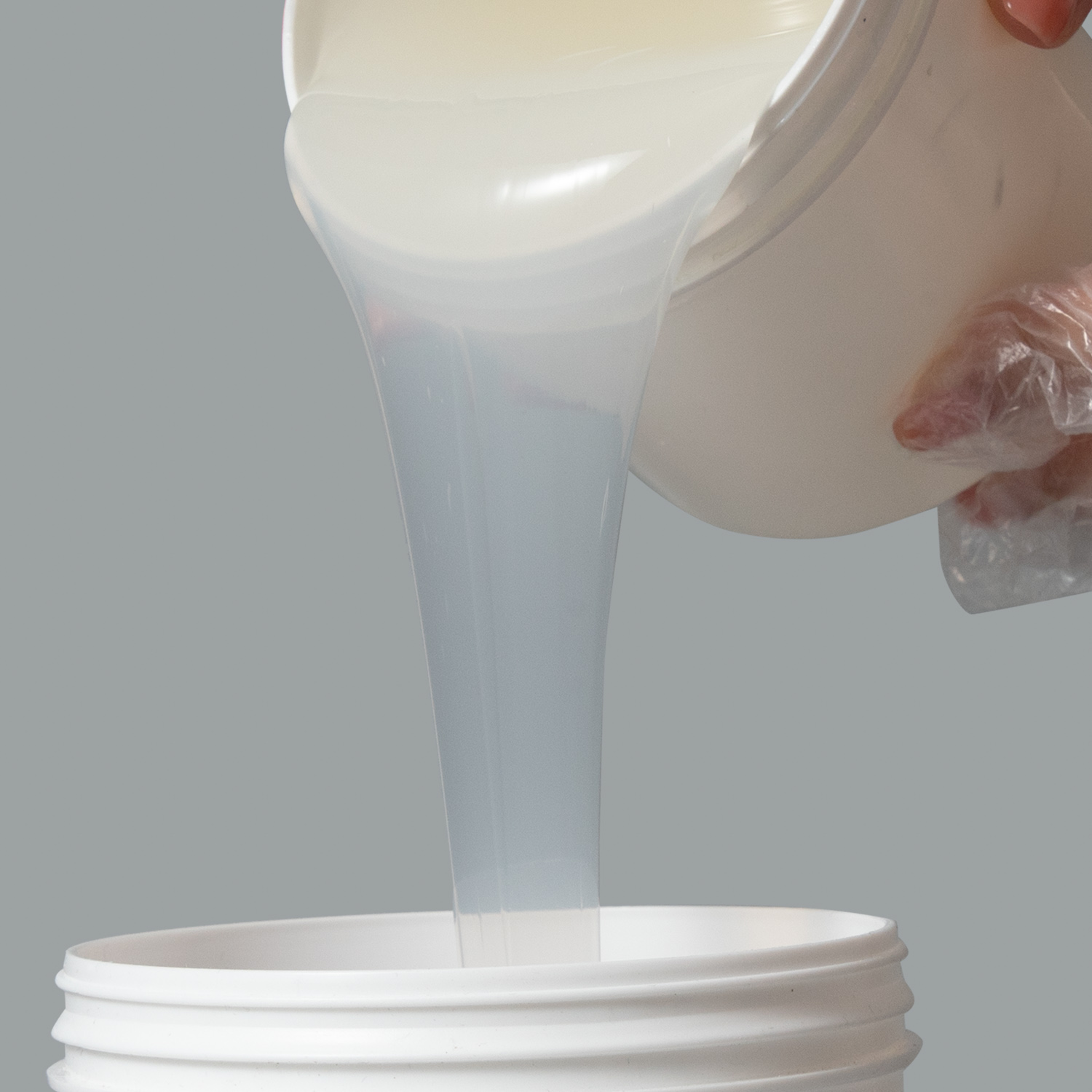
The quality and production efficiency of dough mats largely depend on the performance of core materials. A food-grade addition-cure silicone rubber specially developed for dough mats, with its excellent fluidity and stable performance, has become a powerful assistant in improving dough mat quality, bringing dual upgrades in efficiency and quality for manufacturers.
The "flow wisdom" of this material is key to enhancing production efficiency. It has excellent fluidity, easily penetrating substrate gaps like a "fine emulsion" during construction, and evenly covering surfaces through scraping or dipping processes to ensure a complete protective layer everywhere. This characteristic makes the production process smoother, reduces issues like material accumulation and uneven thickness, lowers post-processing costs, and significantly improves production efficiency.
The balanced design of food safety and physical properties is its core competitiveness. As a food-grade material, it meets safety requirements for direct contact with food, while after curing, it possesses excellent mechanical properties. A hardness of 40 Shore A gives the dough mat a moderately soft hand feel; tensile strength above 6MPa ensures durability; and elongation at break over 300% endows the product with super flexibility, preventing cracks or damage even with long-term use and greatly extending product service life.
Usability further lowers production thresholds. The A and B two-component system is mixed in a 2:100 weight ratio, requiring no complex measuring equipment, and ordinary workers can operate after simple training. The packaging specifications of 2Kg/barrel for component A and 200Kg/barrel for component B can flexibly adapt to different production scales, meeting needs from small-batch trials to large-scale mass production. The mixed viscosity stabilizes at 60000mPa·s, compatible with various coating equipment without the need for additional production line modifications.
Storage and management are also hassle-free: unopened products can be stored for 12 months below 23℃, with packaging labels clearly indicating the expiration date for easy inventory planning. Even if exceeding the shelf life, materials can still be used after passing performance tests, reducing material waste. Whether for specialized dough mat production or processing other food-contact coating products, this material empowers production upgrades with its efficient characteristics.