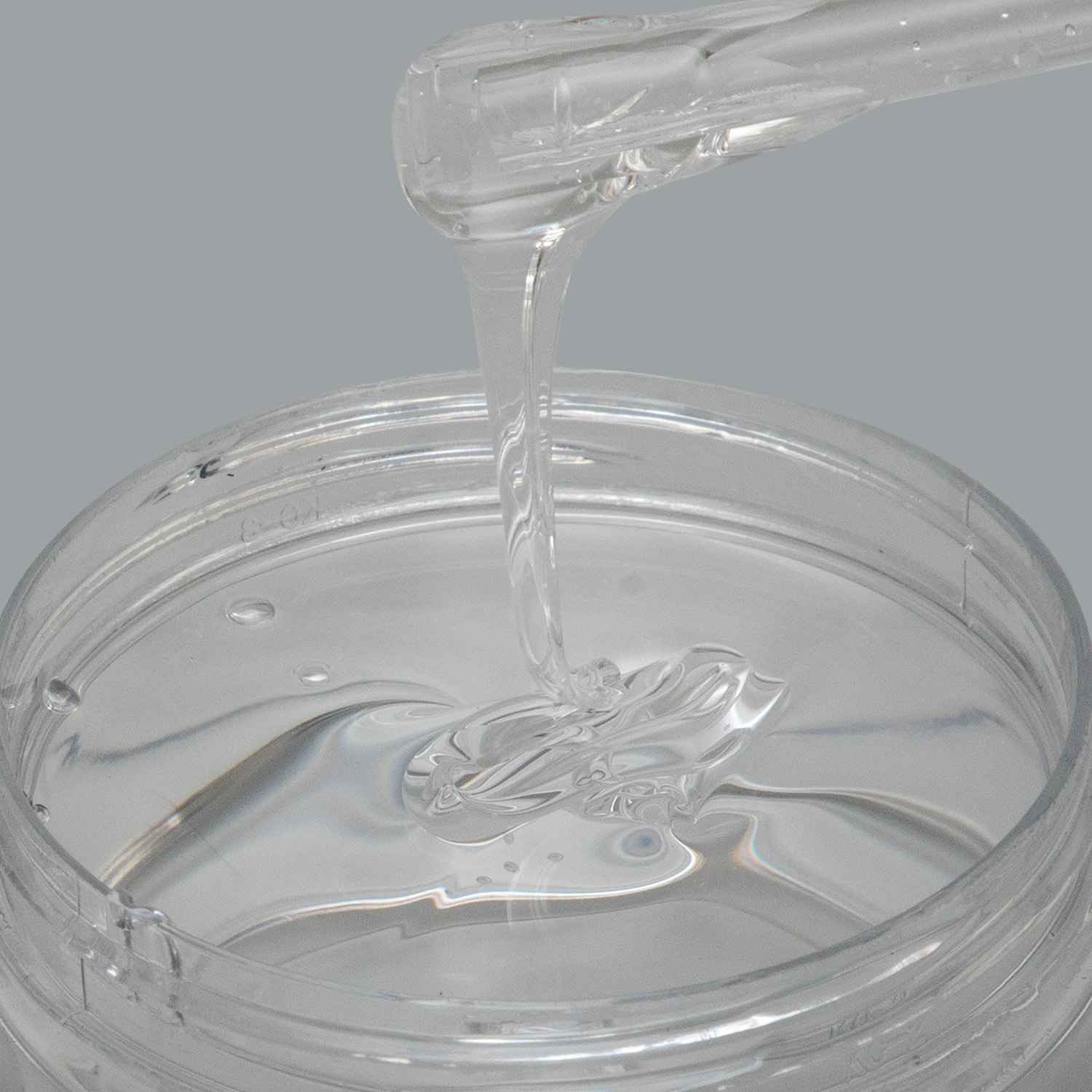
In fields such as displays, automotive electronics, and solar energy, there are extremely high requirements for the transparency, curing convenience, and performance stability of bonding and potting materials. As a low-viscosity addition-type two-component room-temperature curing product, silicone gel IOTA-5118AB has become a high-quality choice for various industries due to its 1:1 mixing ratio, high transparency, and adaptability to multiple scenarios.
In terms of basic properties, both Component A and Component B of this product are colorless and transparent liquids before curing, pure and free of impurities. They remain transparent after mixing, and the light transmittance after curing exceeds 99%, which is almost equivalent to the transparency of glass—making it particularly suitable for scenarios with high light transmission requirements. It also exhibits excellent viscosity performance: the viscosity of Component A is 1600 mPa·s, Component B is 1300 mPa·s, and the mixed viscosity is 1400 mPa·s. With good fluidity, it can easily fill small gaps, ensuring uniform coverage whether bonding display glass coverslips to polarizers or potting electronic components. Its density is 0.97 g/cm³, slightly lighter than water, so it will not add extra weight burden to the base material during use; the refractive index is 1.404, which is compatible with most transparent base materials and will not affect the light transmission effect due to differences in refractive index.
Operational convenience is one of its core advantages. Component A and Component B can be used by mixing at a 1:1 ratio, no complex conversion is required, and it can be easily operated by manual mixing or machine mixing. The curing temperature can be flexibly selected according to needs: it can cure slowly at room temperature (25°C), and can be quickly cured in an oven at 150°C within 30 minutes—the higher the temperature, the faster the curing speed, which adapts to different production rhythms. More flexibly, by adjusting the ratio of Component A to Component B (e.g., from 1.1:1 to 1.6:1), the hardness of the gel after curing can be changed to meet the hardness requirements of different scenarios. For example, when a harder gel is needed, the dosage of Component B can be appropriately reduced.
In terms of performance, the product after curing has significant advantages. It has excellent mechanical damping performance, which can effectively buffer vibration and impact, protecting electronic components and automotive parts from vibration damage; its surface is sticky with reliable bonding strength, which can firmly bond display glass coverslips to polarizers without easy detachment. It also has outstanding electrical properties: the relative dielectric constant is 2.7, the dielectric loss is as low as 10×10⁻⁴, and the insulation effect is good; the volume resistance is 10¹⁶ Ω·cm and the surface resistance is 10¹⁴ Ω, which can effectively insulate current and ensure the electrical safety of electronic components; the dielectric strength is 23 kV/mm, enabling stable operation even in high-voltage environments, making it suitable for potting protection in high-voltage scenarios such as electronics and automotive applications.
It is available in two packaging specifications: 15KG/barrel and 180KG/barrel. Component A and Component B are supplied in a matched set, adapting to small-batch trial production and large-scale mass production. During storage, it only needs to be sealed and placed in an environment of 5-30°C, with a shelf life of 6 months, facilitating enterprises to stock up. When using, it is necessary to clean the surface of the base material and avoid contact with substances containing elements such as sulfur, phosphorus, and nitrogen to prevent affecting the curing effect.