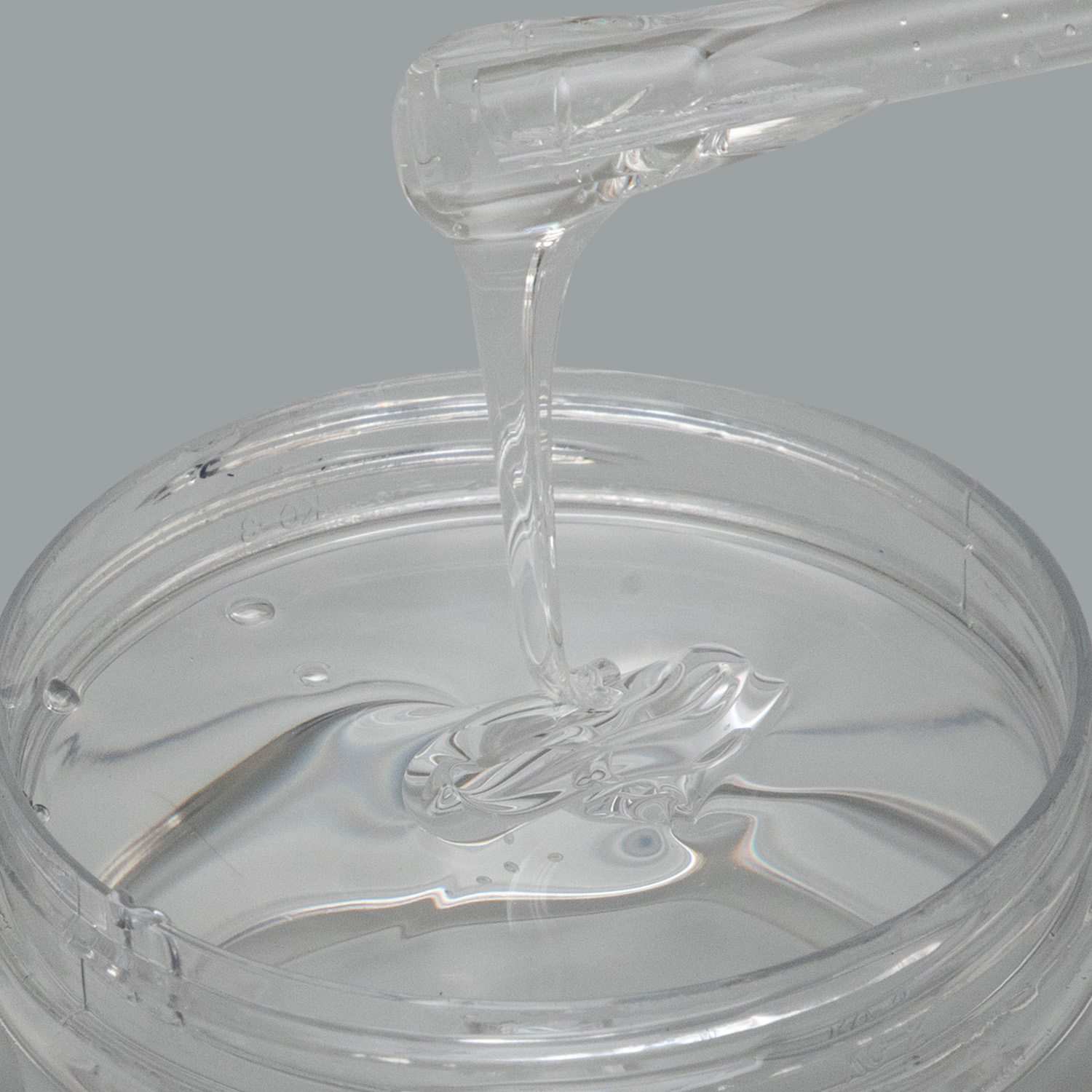
In material selection, it’s often difficult to have both "Property A and Property B"—good insulation may come with poor light transmittance, and strong fluidity may mean inappropriate hardness. However, the silicone gel IOTA-5118AB breaks this limitation: it can be either flexible or rigid (with adjustments), while also featuring high light transmittance and strong insulation. Just like a "versatile expert", it easily adapts to the needs of multiple fields such as displays, electronics, and solar energy.
Its "versatility" is first reflected in adjustable hardness. When mixed at the default A:B ratio of 1:1, it cures into a low-hardness viscous gel that feels soft—suitable for scenarios requiring buffering and bonding, such as bonding the glass cover of a display, which ensures tight adhesion without damaging the substrate. If damping products need to be produced or a slightly harder gel is required, simply adjust the ratio slightly: increase the amount of Component A and reduce Component B (e.g., adjust to 1.1:1, 1.3:1, or even 1.6:1). The cured gel will then become harder, transforming from "soft and limp" to "elastic", meeting the hardness requirements of different scenarios without the need to switch to different materials for hardness issues.
Furthermore, its "basic performance" is extremely solid. With a light transmittance of over 99%, it is as transparent as glass after curing—when used for display bonding or solar cell potting, it does not affect light transmission at all. Its insulation performance is even more outstanding: with a dielectric strength of 23kV/mm, it will not be broken down even in high-voltage environments. When potting electronic components, it can effectively insulate current and prevent short circuits. With a density of only 0.97g/cm³ (slightly lighter than water), it does not add extra weight when applied to substrates, making it particularly friendly to precision components.
There’s also no "threshold" for operation. Component A and Component B can be mixed in a 1:1 ratio, eliminating the need to remember complex proportions. After mixing, it has a 1.5-hour working time at 25℃, allowing sufficient time for preparation and application without worrying about rapid solidification that wastes materials. The curing conditions are also flexible: it can cure at room temperature, and high temperature can accelerate the process—curing can be completed in 30 minutes at 150℃, putting you in control of the production rhythm. The only thing to note is that the substrate surface must be cleaned thoroughly and should not come into contact with substances containing sulfur, phosphorus, or organotin, as this may affect the curing effect.
It is packaged in 15KG small barrels and 180KG large barrels, with Component A and Component B supplied as a set—suitable for both R&D trial production and mass production. When stored in a sealed container in an environment of 5-30℃, its shelf life is 6 months, making inventory management hassle-free. For enterprises needing "one material for multiple uses", this versatile silicone gel—capable of being flexible or rigid with comprehensive performance—is undoubtedly a cost-effective choice.